

How much does wedding ceremony music cost in San Diego?
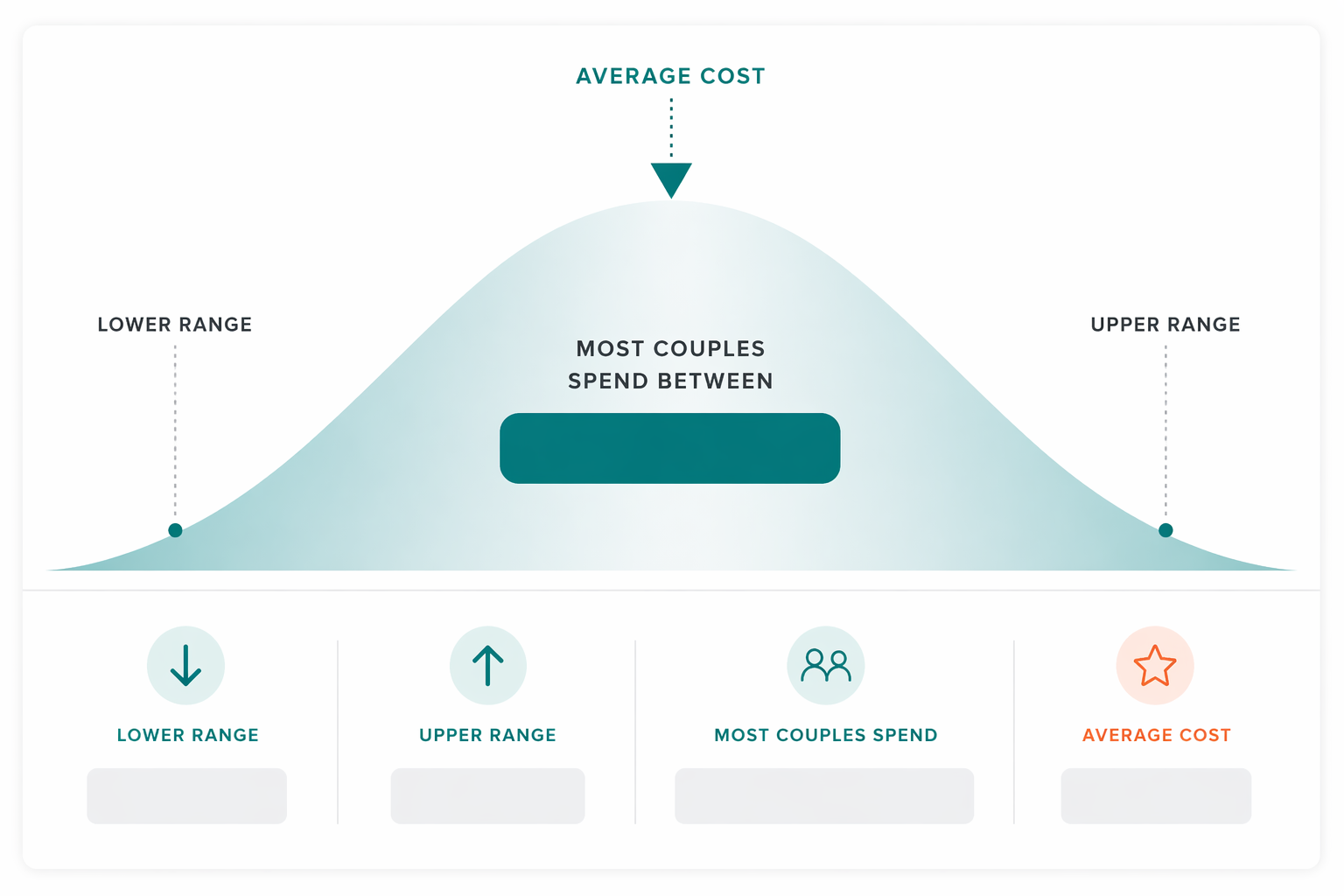
Ceremony music is priced by who is playing. Most San Diego couples spend roughly $500 to $1,500 for the ceremony itself, with the full market running from around $400 to $3,000.
A solo guitarist, harpist or vocalist is generally the most affordable option. A string trio or quartet — the fuller, more formal sound — typically costs $1,000 to $3,000 for the ceremony. A harpist may be quoted hourly, often in the region of $300 to $700 per hour.
If you want the same musicians to carry on through cocktail hour, expect to add roughly $500 to $1,500.
What moves the price
How many musicians. A soloist, a duo, a trio and a quartet are a straightforward progression in price.
How long they play. Ceremony music is not just the processional. It usually covers prelude music as guests arrive, the processional, one or two pieces during the ceremony, and the recessional — often close to an hour of playing for a twenty-minute ceremony.
Whether they stay for cocktail hour. The most common extension, and priced as additional time.
Custom arrangements. A pop song arranged for string quartet is real work. Pieces already in the repertoire cost nothing extra.
Amplification. Outdoors — which in San Diego is most ceremonies — acoustic instruments need a PA to be heard over wind and surf. Some ensembles include it and some do not.
Travel and conditions. Getting a harp or a double bass onto a beach, a bluff or a ranch an hour inland is a genuine logistical cost. Musicians will also decline direct sun and sand for instruments, so shade may be a requirement rather than a preference.
What you get at the average
A typical San Diego ceremony booking covers roughly an hour of music — prelude, processional, an interlude and recessional — performed by the agreed ensemble, with music chosen from their repertoire and coordinated with your officiant and planner on cues. Setup, travel within the metro area and basic amplification are often included, but confirm all three.
Good ceremony musicians earn their fee in the cues. Knowing when to stretch the processional because the wedding party is slow, and when to land the final chord, is the difference between a ceremony that flows and one that stalls.
Add-ons that raise the cost
- Cocktail-hour coverage, the most common extension.
- Extra musicians — adding a cello or a vocalist to a duo.
- A custom arrangement of a song not in the repertoire.
- A sound system with microphones for the officiant and vows.
- A second location, if ceremony and cocktails are far apart on the property.
- Rehearsal attendance, occasionally requested for complex ceremonies.
- Travel to outlying parts of the county.
- Shade or cover provision, where instruments cannot sit in direct sun.
Insurance, sound and vetting
Ask about liability insurance — most San Diego venues require a certificate from every vendor on site.
Then talk to your venue about sound. Coastal and outdoor properties here frequently have amplified-sound limits and curfews, and a ceremony on a bluff or beach can be genuinely inaudible without amplification. Establish who is providing the microphone for the officiant and the vows: often it is the DJ rather than the ceremony musicians, and assuming the other party has it covered is how ceremonies end up unamplified.
Listen to recordings of the actual ensemble, not a generic sample, and confirm which players are contracted for your date. Agencies book from a pool; that is standard, but the contract should name what you are getting.
How to save on ceremony music
- Book a soloist or duo instead of a quartet. A single cellist or guitarist carries an outdoor ceremony well.
- Choose from the existing repertoire and avoid arrangement fees.
- Have your DJ cover the prelude and bring live musicians in only for the processional and recessional.
- Skip live music at cocktail hour and use recorded music through the DJ’s system.
- Share the sound system. If your DJ is already providing ceremony sound, the musicians may not need their own.
- Use the DJ for everything if the budget is tight — a well-chosen recorded processional through a good PA beats a poorly amplified live one.
- Take an off-season or weekday date.
What to ask before you book
- How many musicians, and which ones are contracted for our date?
- How long do you play, and what does that cover?
- Do you provide amplification, or does our DJ?
- Who supplies the microphone for the officiant and vows?
- Can we hear a recording of this exact ensemble?
- Will you learn a song that is not in your repertoire, and at what cost?
- What do you need at an outdoor venue — shade, power, a flat surface?
- Are you insured, and is there a travel fee to our venue?


